People, Dogs, and Public Spaces Strategy

Share People, Dogs, and Public Spaces Strategy on Facebook Share People, Dogs, and Public Spaces Strategy on Twitter Share People, Dogs, and Public Spaces Strategy on Linkedin Email People, Dogs, and Public Spaces Strategy link

The City of Port Moody is developing a People, Dogs, and Public Spaces Strategy to guide decision-making related to parks and trails, off-leash areas, dog-friendly amenities (city-wide), bylaw enforcement, and community education. As part of Phase 1 public engagement, we want to hear about your experiences related to dogs in public spaces.

The overarching goal of the Strategy will be to help people and dogs share Port Moody’s public spaces responsibly and respectfully. It will be a city-wide framework that balances access and amenities for dog owners/walkers with ecological protection and safe enjoyment of public spaces for all residents and visitors.

The strategy will focus on actions – such as operational, educational, and stewardship initiatives – that can be carried out with existing resources, while also identifying opportunities for exploration as future funding becomes available. This will give us a framework that is both practical and adaptable as the community’s needs evolve.


Here's how you can get involved:

1. Join us at an information pop-up

Visit us at an information pop-up where you can find out more about why we’re developing the Strategy and learn about existing dog-related amenities and bylaws. We invite you to talk to City staff and ask questions.

Date

Time

Location

Pop-up #1

Saturday, March 21

12-2pm

Rocky Point Park, 2800 block Murray Street (plaza near spray park)

Pop-up #2

Friday, March 27

1-3pm

Bert Flinn Park, 1300 David Avenue (entrance at David Avenue and Heritage Mountain Boulevard)

Pop-up #3

Wednesday, April 1

4-6pm

Recreation Complex, 300 Ioco Road (outdoor plaza near main entrance)

2. Fill out our community survey

Take the community survey by Monday, April 6, 2026. If you prefer to fill out a paper survey, you can pick one up at City Hall (100 Newport Drive) during business hours and return your completed form to the same location by Thursday, April 2, 2026.


Learn more:

The information that will be presented at the pop-ups is also available on this page. Learn about:


How will we use your input?

The results of the community survey will help the City’s project team develop broad recommendations for inclusion in Port Moody’s People, Dogs, and Public Spaces Strategy. During Phase 2, which we anticipate will begin in spring 2027, we’ll ask the community for feedback on the recommendations. Following the completion of each phase, a public engagement summary will be shared with Council in a staff report and with the public via a link to that report on this page.

In developing the Strategy, community input will be considered along with technical information, advice provided by subject matter experts, strategic goals, and other plans or strategy documents. After public engagement has concluded, staff will present the draft Strategy to Council for their consideration.


The City of Port Moody is developing a People, Dogs, and Public Spaces Strategy to guide decision-making related to parks and trails, off-leash areas, dog-friendly amenities (city-wide), bylaw enforcement, and community education. As part of Phase 1 public engagement, we want to hear about your experiences related to dogs in public spaces.

The overarching goal of the Strategy will be to help people and dogs share Port Moody’s public spaces responsibly and respectfully. It will be a city-wide framework that balances access and amenities for dog owners/walkers with ecological protection and safe enjoyment of public spaces for all residents and visitors.

The strategy will focus on actions – such as operational, educational, and stewardship initiatives – that can be carried out with existing resources, while also identifying opportunities for exploration as future funding becomes available. This will give us a framework that is both practical and adaptable as the community’s needs evolve.


Here's how you can get involved:

1. Join us at an information pop-up

Visit us at an information pop-up where you can find out more about why we’re developing the Strategy and learn about existing dog-related amenities and bylaws. We invite you to talk to City staff and ask questions.

Date

Time

Location

Pop-up #1

Saturday, March 21

12-2pm

Rocky Point Park, 2800 block Murray Street (plaza near spray park)

Pop-up #2

Friday, March 27

1-3pm

Bert Flinn Park, 1300 David Avenue (entrance at David Avenue and Heritage Mountain Boulevard)

Pop-up #3

Wednesday, April 1

4-6pm

Recreation Complex, 300 Ioco Road (outdoor plaza near main entrance)

2. Fill out our community survey

Take the community survey by Monday, April 6, 2026. If you prefer to fill out a paper survey, you can pick one up at City Hall (100 Newport Drive) during business hours and return your completed form to the same location by Thursday, April 2, 2026.


Learn more:

The information that will be presented at the pop-ups is also available on this page. Learn about:


How will we use your input?

The results of the community survey will help the City’s project team develop broad recommendations for inclusion in Port Moody’s People, Dogs, and Public Spaces Strategy. During Phase 2, which we anticipate will begin in spring 2027, we’ll ask the community for feedback on the recommendations. Following the completion of each phase, a public engagement summary will be shared with Council in a staff report and with the public via a link to that report on this page.

In developing the Strategy, community input will be considered along with technical information, advice provided by subject matter experts, strategic goals, and other plans or strategy documents. After public engagement has concluded, staff will present the draft Strategy to Council for their consideration.


  • What we’re doing and why it matters

    Share What we’re doing and why it matters on Facebook Share What we’re doing and why it matters on Twitter Share What we’re doing and why it matters on Linkedin Email What we’re doing and why it matters link

    The City of Port Moody is developing a People, Dogs, and Public Spaces Strategy to guide decision-making related to parks and trails, off-leash areas, dog-friendly amenities (city-wide), bylaw enforcement, and community education.

    Why this matters

    • More people – including more people with dogs – are using Port Moody’s parks, trails, and other shared spaces.
    • Busy, shared spaces mean more interactions between different groups, including people with dogs and people without dogs.
    • Safety and comfort are important for everyone.
    • Clear rules and community education can help everyone understand where and how dogs can be present in public spaces.
    • Thoughtful use and shared stewardship help to protect natural areas and ecosystems.
    • A city-wide strategy will help us balance access and amenities for dog owners/walkers with ecological protection and safe enjoyment of public spaces for all residents and visitors.

    Project timeline

    1. Background research and analysis (fall 2025-winter 2026)
    2. Phase 1 engagement (spring 2026) – your experiences related to dogs in public spaces
    3. Phase 2 engagement (spring 2027) – feedback on recommended approaches for the Strategy
    4. Draft strategy for Council’s consideration (summer 2027)
  • Current trends in Port Moody’s public spaces

    Share Current trends in Port Moody’s public spaces on Facebook Share Current trends in Port Moody’s public spaces on Twitter Share Current trends in Port Moody’s public spaces on Linkedin Email Current trends in Port Moody’s public spaces link

    Why do we need a People, Dogs, and Public Spaces Strategy? Here’s what we’re seeing in the community:

    • existing off-leash areas and amenities (see map) are serving a growing number of people and dogs
    • new residential developments typically offer limited opportunities for dog‑related amenities on site
    • there is a need for more consistent signage in and around designated off-leash areas
    • dogs are off leash in areas where they are required to be on leash, leading to conflicts or uncomfortable interactions between walkers, hikers, cyclists, children, and dogs, as well as negative impacts on wetlands, wildlife, and environmentally sensitive areas
    • a considerable amount of dog waste, both bagged and unbagged, is being left behind in shared spaces

    The Strategy will be a city-wide framework that balances access and amenities for dog owners/walkers with ecological protection and safe enjoyment of public spaces for all residents and visitors.

  • Dogs off-leash in on-leash areas: what's the problem?

    Share Dogs off-leash in on-leash areas: what's the problem? on Facebook Share Dogs off-leash in on-leash areas: what's the problem? on Twitter Share Dogs off-leash in on-leash areas: what's the problem? on Linkedin Email Dogs off-leash in on-leash areas: what's the problem? link

    With the exception of designated off-leash areas, dogs must be on leash at all times in public spaces including parks and trails. Many dog owners and dog walkers follow the rules (see Animal Control Bylaw 3343 – Section 5.1). But increasingly, we are seeing dogs off leash in areas where they are required to be on leash, leading to conflicts or uncomfortable interactions between walkers, hikers, cyclists, children, and dogs. When an unwanted interaction occurs, sometimes a dog owner/walker will say, "It's okay - my dog is friendly!" So, if the dog is friendly, what's the problem?

    No matter how friendly a dog may be, an interaction might cause anxiety or lead to an injury - for a person and/or a dog. Safety and comfort are important for everyone, and both can be achieved when people and dogs share public spaces responsibly and respectfully.

    If you own or care for a dog, we encourage you to think about how others may be affected when you allow your dog off leash in an on-leash area. Even if your dog is friendly, its actions/behaviours could surprise or startle people and/or other dogs, and conflicts or uncomfortable interactions could arise. In our community's shared spaces, please be respectful of the people and dogs around you including:

    • reactive dogs on leash
    • cyclists and runners
    • small children and their parents/caregivers
    • people with mobility challenges (who may be using a mobility device such as a cane, walker, scooter, or wheelchair)
    • people who have a fear of dogs and/or who have experienced negative interactions with dogs in the past

    By keeping your dog on a leash, you can help to ensure that Port Moody's parks, trails, and other public spaces are enjoyable for everyone.

  • Dog waste in public spaces: health and environmental impacts

    Share Dog waste in public spaces: health and environmental impacts on Facebook Share Dog waste in public spaces: health and environmental impacts on Twitter Share Dog waste in public spaces: health and environmental impacts on Linkedin Email Dog waste in public spaces: health and environmental impacts link

    While many dog owners/walkers consistently pick up dog waste and dispose of it properly, some do not, and even a relatively small number of missed clean‑ups leads to an accumulation over time. In August 2025, the City collected dog waste data from Bert Flinn Park. Based on observations from 223 sample sites, we estimate 490 kilograms (1,080 pounds) of dog waste was left within 20 metres of trails where dogs are required to be on leash. Higher volumes of waste were noted near the main park entrances, particularly the David Avenue entrance. This level of accumulation indicates there is a recurring pattern of uncollected waste with measurable impacts on park conditions, maintenance needs, and visitor experience.

    Dog waste is not the same as waste left by wildlife

    Some park users may assume that unbagged dog waste can be left in nature because that's what wild animals do. However, there are key differences that mean dog waste should be picked up and disposed of properly.

    Volume and concentration

    Wild animals disperse waste across large territories, whereas dogs being walked on designated trails tend to leave their waste repeatedly in concentrated, high‑use locations. Over time, this leads to high waste levels that cannot be broken down effectively by natural systems, as demonstrated by the Bert Flinn Park data.

    Public and pet health

    Uncollected dog waste can carry a range of harmful microorganisms that pose preventable health risks to people and pets in Port Moody’s parks, trails, and other public spaces. A single gram of dog feces can contain millions of bacteria, including E. coli, Salmonella, and Campylobacter, all of which can cause illness in humans and animals.

    Additional pathogens identified by the Canadian Public Health Association - such as Giardia, Cryptosporidium, and roundworms - can persist in soil and remain infectious long after waste was first left behind. Children face elevated risk due to their frequent ground contact and hand‑to‑mouth behaviours, especially in grassy or natural areas where contaminated soil may be present. These risks highlight the importance of consistent waste pickup and proper disposal to maintain safe, healthy, and enjoyable shared public spaces.

    Impacts on ecosystems

    High volumes of dog waste introduce excess nutrients, particularly nitrogen, which can disrupt natural soil processes. Most ecosystems are naturally low-nutrient environments. When there are excess nutrients, this reduces biodiversity by allowing a few thriving plants to drive out others and the wildlife that depends on them.

    Biodegradable bags are not the answer

    Approximately 15 per cent of the dog waste observed during data collection in Bert Flinn Park was left behind in bags. This suggests a common misunderstanding about “biodegradable” dog‑waste products. Many bags marketed as "biodegradable" are made from bio‑plastics, which break down into microplastics that contribute to long‑term environmental pollution rather than decomposing cleanly.

    Bio‑plastics typically require high temperatures - far above those naturally occurring in Port Moody’s parks, soils, or forest understory - to break down efficiently. As a result, discarded bags can remain for years, contributing to litter, interfering with natural decomposition processes, posing additional hazards to wildlife, and having a negative impact on users' enjoyment of our parks and other public spaces.

    What to do with dog waste?

    Whether it's bagged or unbagged, leaving dog waste in parks and other public spaces has negative impacts on the health of people and dogs, and on Port Moody's ecosystems. If you are out walking your dog, please dispose of waste properly. Here are two recommended methods:

    1. Put it in a red dog waste bin. The City of Port Moody has set up red bins for dog waste in or near a number of parks and green spaces. (These bins are to be used for dog waste generated during a walk or a visit in one of these spaces. Dog waste generated at the pet’s home or other location should be disposed of properly in the home.) Waste collected in the red bins is taken to the Iona Island wastewater treatment plant. Our goal is to reduce the amount of dog waste that goes to a landfill. When in the landfill, dog waste produces methane as it breaks down, which is a greenhouse gas. Dog waste is better dealt with at a wastewater treatment plant.

    2. Take it home with you and flush it down the toilet (without the bag - do not flush the bag even if it's labelled "flushable" or "biodegradable"). Metro Vancouver recommends flushing (without the bag) to ensure the dog waste will go to a wastewater treatment plant with other sewage instead of a landfill. (Note: do not flush cat waste down the toilet.)
  • Developing the Strategy

    Share Developing the Strategy on Facebook Share Developing the Strategy on Twitter Share Developing the Strategy on Linkedin Email Developing the Strategy link

    In developing Port Moody’s People, Dogs, and Public Spaces Strategy, the City's project team will explore a variety of approaches aimed at helping people and dogs share public spaces responsibly and respectfully such as:

    • making improvements to existing off-leash areas such as:
      • adding and/or updating signage
      • reviewing dog waste management approaches
    • conducting an assessment to determine if there are opportunities for new off-leash areas or enhancements to existing off-leash areas
    • updating policies and procedures related to bylaw enforcement
    • developing a community education campaign to increase knowledge of rules and health/safety considerations
    • developing park design recommendations that improve compatibility among different user groups
    • identifying opportunities for community participation in stewardship activities
    • developing guidelines for integrating dog-related amenities into multi-unit developments
    • aligning dog-related uses of parks and trails with environmental protection objectives


    The results of Phase 1 engagement will help the City’s project team develop broad recommendations for inclusion in Port Moody’s People, Dogs, and Public Spaces Strategy. During Phase 2, which we anticipate will begin in spring 2027, we’ll ask the community for feedback on the recommendations. Following the completion of each phase, a public engagement summary will be shared with Council in a staff report and with the public via a link to that report on this page.

    Community input will be considered along with technical information, advice provided by subject matter experts, strategic goals, and other plans or strategy documents. After public engagement has concluded, staff will present the draft Strategy to Council for their consideration.

    The strategy will focus on actions – such as operational, educational, and stewardship initiatives – that can be carried out with existing resources, while also identifying opportunities for exploration as future funding becomes available. This will give us a framework that is both practical and adaptable as the community’s needs evolve.

  • Good to know: City bylaws

    Share Good to know: City bylaws on Facebook Share Good to know: City bylaws on Twitter Share Good to know: City bylaws on Linkedin Email Good to know: City bylaws link

    City of Port Moody bylaws regulate where and how dogs can be present in public spaces to:

    • help keep people and dogs healthy and safe; and
    • protect our natural environment.

    Here are some important rules for dog owners and anyone walking a dog in a public space:

    • if your dog is four months or older, you’ll need to purchase a dog licence and renew it each year. (Animal Control Bylaw 3343 – Section 4.2)
    • dogs must be on leash in all parks, trails, and public spaces except for designated off-leash areas. (Animal Control Bylaw 3343 – Section 5.1)
    • in off-leash areas, your dog must be under control and able to respond to your verbal commands. (Animal Control Bylaw 3343 – Section 5.2)
    • when walking a dog in a public space, you must pick up dog waste and dispose of it properly by taking it home or placing it in one of the City’s red dog waste bins. (Animal Control Bylaw 3343 – Section 5.4)
    • dogs are not permitted on the beach at Old Orchard Park, or on Port Moody sports fields, running tracks, tennis/sports courts, playgrounds, and spray parks, or in the Westhill Sports Box. (Parks and Community Facilities Rules and Regulations Bylaw 3321 – Section 11.2)
  • Good to know: designated off-leash areas and amenities

    Share Good to know: designated off-leash areas and amenities on Facebook Share Good to know: designated off-leash areas and amenities on Twitter Share Good to know: designated off-leash areas and amenities on Linkedin Email Good to know: designated off-leash areas and amenities link

    Dogs are allowed off leash in Port Moody in six designated off-leash areas*:

    1. Bert Flinn Park – wide gravel path (David Avenue at Heritage Mountain Boulevard)
      The straight, wide gravel path that begins at the David Avenue entrance is an all-day off-leash area. Amenities: dog waste bag dispenser; red dog waste bins at three spots along the path, and seating (park benches).

    2. Bert Flinn Park – Morning Off-Leash Mini Loop (Pilot) (David Avenue at Heritage Mountain Boulevard)
      The Morning Off-Leash Mini Loop (Pilot) is a nature trail that branches westward off Bert Flinn Park’s existing wide gravel path. During a one-year pilot period, dog walkers may have their dogs off-leash between 6am and 10am daily. Amenities: nearby on the wide gravel path (see above).

    3. Chines Park (Jane Street at Hugh Street)
      The off-leash area in Chines Park is a small, flat, unfenced area adjacent to where Goulet Creek enters a culvert. This off-leash area connects to a network of non-maintained hiking trails where dogs must be on leash. Amenities: dog waste bag dispenser and dog waste bin.

    4. Westhill Park (203 Westhill Place)
      This off-leash area, located at the north end of Westhill Park, is made up of mostly nature trails but does include a small, open, unfenced area. Amenities: dog waste bag dispenser and red dog waste bin at the parking lot entrance.

    5. Rocky Point Park – large dog area (2800 block Murray Street)
      This is a fenced off-leash area with open space, adjacent to the Murray Street sidewalk and next to Slaughterhouse Creek. Amenities: dog waste bag dispenser, dog-friendly water fountain, and seating (picnic benches and logs).

    6. Rocky Point Park – small dog area (2800 block Murray Street)
      This is a fenced off-leash area with open space, next to the large dog area. Amenities: nearby at the large dog area.


    Find existing City-owned off-leash dog areas and amenities on the map below.

    *In all other public spaces, including parks and trails, dogs must be on leash at all times.
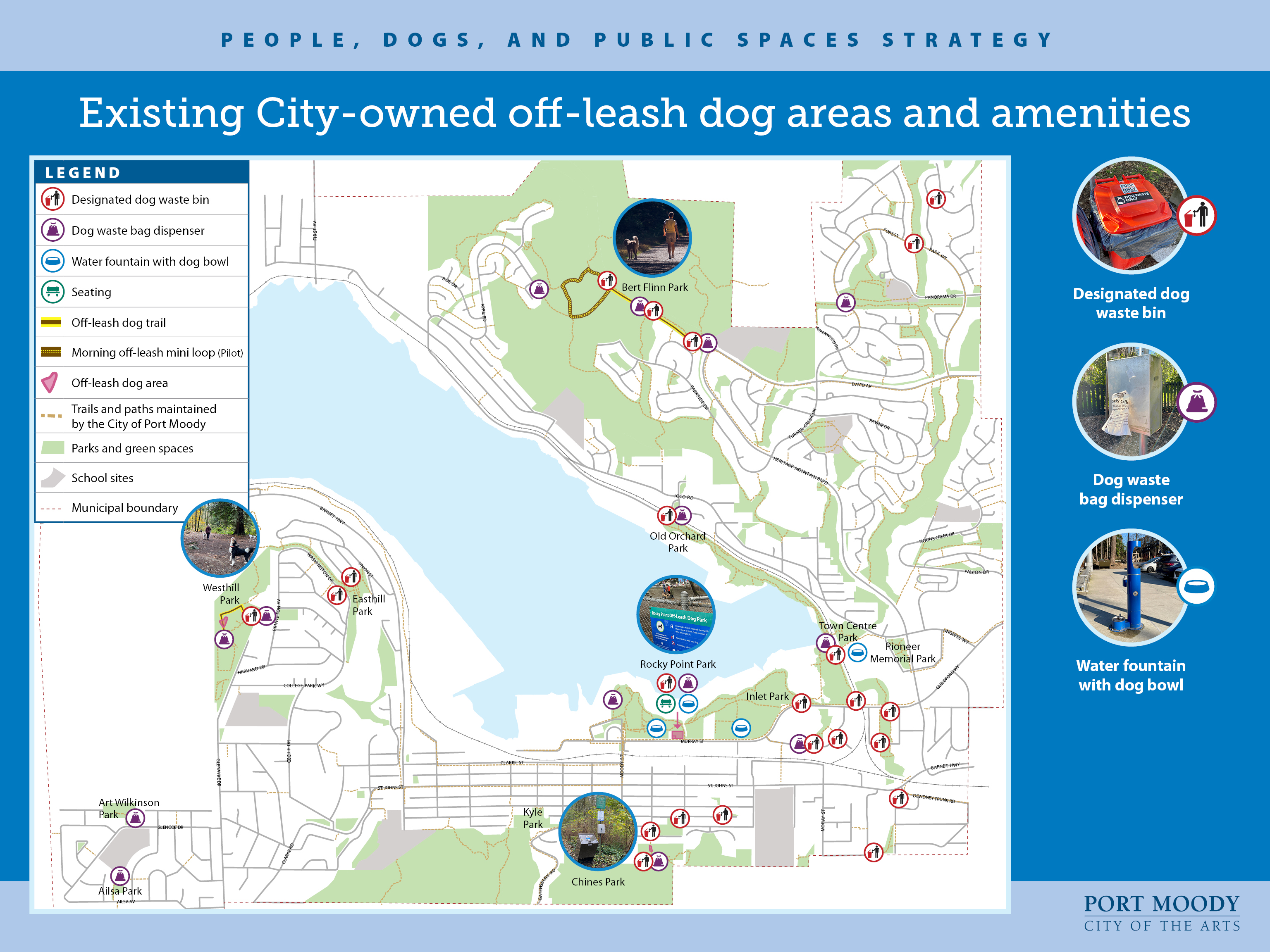
    On mobile device, drag two fingers (pinch out) to zoom in. On desktop, click image for larger view.

  • Good to know: quick facts about dogs in Port Moody

    Share Good to know: quick facts about dogs in Port Moody on Facebook Share Good to know: quick facts about dogs in Port Moody on Twitter Share Good to know: quick facts about dogs in Port Moody on Linkedin Email Good to know: quick facts about dogs in Port Moody link

    Here are some quick facts related to licensing, estimated dog population, and tickets issued for bylaw contravention:

    Licensing

    • Under the City’s Animal Control Bylaw, all dogs four months or older must have a dog licence, which must be renewed annually.
    • Licensed dogs are provided with a permanent, bone-shaped metal tag to be worn on their collar (new tags are not issued on an annual basis).
    • Revenue from dog licence fees goes toward funding animal control services, the City’s animal shelter service contract, public safety, and the care of lost or abandoned pets.
    • As of February 2026, there are 2,471 licensed dogs in Port Moody.

    Estimated dog population

    • The number of licensed dogs in Port Moody is likely significantly lower than the total number of dogs.
    • Using data from Statistics Canada, Agriculture Canada, and the Canadian Animal Health Institute, we can estimate the number of dogs (with or without a licence) in Port Moody to be between 5,700 and 7,042.
    • Using the current number of licensed dogs in Port Moody, we can estimate that between 35 and 43 per cent of dogs in the city are licensed.
    • These estimates align with numbers estimated by the City of Vancouver and the District of Saanich based on statistically sound phone surveys.


    Tickets issued

    • Bylaw enforcement officers issue municipal tickets related to dogs for a variety of reasons such as failure to obtain a licence or a dog being at large (loose in the community).
    • The following table shows the number of dog-related bylaw tickets issued annually over the past 10 years:

      Table 1: Dog-Related Bylaws Tickets Issued by Year

      Year

      Number of Tickets Issued

      2015

      14

      2016

      37

      2017

      29

      2018

      31

      2019

      34

      2020

      37

      2021

      38

      2022

      53

      2023

      62

      2024

      64

      2025

      79

    • Year-over-year increases in the number of tickets can be attributed to a variety of factors including an increase in the number of dogs in Port Moody, increased bylaw enforcement patrols particularly in spring/summer, and higher demand for parks, trails, and other public spaces since the global COVID-19 pandemic.
Page last updated: 09 Mar 2026, 10:13 AM